Wednesday, June 9, 2010

Summer Music Festivals!

(posted by: Ruth Butterfield-Winter)

So, it's now time for Summer Music Festivals. If you haven't signed up to participate in one of the many events and festivals around the country and the world, it might be too late. But it's not too late to plan to attend one. All you have to do is type "summer music festival" in your browser's search engine and you'll seen a whole list of possibilities.

What's so great about Summer Music Festivals?

Well, a lot of them offer performances of great internationally known artists who perform with local artists and the concerts are often free. Many of the concerts are staged in nature, complete with wind and rain if the weather decides to join in. Often, the performances are casual, so you get to see the personality of the performers more transparently than if you were to attend a formal performance in a concert hall. Also, you may get to sit very close to the stage, which allows you to see the music, feel the breath, and taste the sweat (not literally, most times) of the performers.

Sound fun so far?

How about attending master classes with the great artists? Have you ever wondered how a great artist thinks? You know what; they think like anyone else. They can translate what they think into action and project their thoughts and feels through their skill and talent to the audience. Going to a master class of a great operatic baritone may give you insights into how you can hone your own skill. Whether it's landscaping, graphic design, computer programming or housekeeping, you may learn how to approach your own profession by using the principles you hear during a master class. It could happen.

What would you say if you could actually read music with an internationally know artist? It would be like playing tennis with Pete Sampras! OK, it probably wouldn't be too much fun for him, but it would be a thrill for me. (stuff to tell my grandkids, or anyone who will listen....)

Usually Summer Music Festivals happen in places that have a lot of other cultural attractions. Going to Aspen, CO for the Music Festival may open your world up to a pottery studio that enhances your outlook on shape & form. You may see a play or eat a kind of cuisine only authentically found in that town. ... exciting stuff ...

Think about it, if you've never been to a Summer Music Festival. If you have, which one is your favorite? Have you ever been lucky (fortunate) enough to share or play with a great musician or artist? If so, tell me about it.

Tuesday, May 4, 2010

Always Perform For Your Favorite Audience!

posted by Ruth Butterfield-Winter

Have you ever performed to a crowd of thousands, even 10's of thousands? I am not surprised if you have. What a thrill that is. The accomplishment of working an entire program or set of music out in the practice studio and presenting it to a crowd where you absolutely know people in the audience get what you are trying to say with your art. It's beyond words, it's exhilarating, it's worth every bit of sweat, tears, blood, sacrifices and curses for your gift.

Now, think about this: Have you ever worked so hard on a program that you know it will no doubt change the world as you know it? The concert date approaches and you realize that half your friends have other gigs, your family is out of town on vacation and you were so busy practicing that you forgot to send out the notices to churches, distribution lists and local media. OH NO, your manager (if you have one) dropped the ball too! The audience is going to be minuscule. Maybe, if it's cold, someone will come in just for the shelter from the elements.

Let me ask you... Would you present your art, your songs, your playing, your performance any differently with one person in the audience, then you would with thousands?

It's only natural to throw up your hands and say, "What's the point? Nobody is going to hear this. That one person couldn't possible understand the intellectual and technical skill I am presenting. At least with 50 people in the audience, at least one will get it."

I say, every time we sing, rehearse, play, paint, write, whatever the skill is, we should perform, or at least strive to execute, at the level we would if the most influential person in your life, living or dead, were in the audience.

For me, that special influential person is Dr. Vladimir Sokoloff (pictured with me sitting at the piano), my piano teacher at The Curtis Institute of Music in Phila- delphia. We had weekly student recitals and I seemed to be on most of them, since I was a Chamber Music/Accompanying major. Dr. Sokoloff was in the audience every for concert. He would take a seat in the back row near the left hand exit. He was very proud of his students, but praise from him was extremely rare. If he liked what you had done; and man, you knew when you did well even before he came up after the concert, he would say, "Not bad." You could breath easy after that because you knew you were golden for at least an hour, or until the next lesson.

Dr. Sokoloff died in 1997. But still, when I prepare for a concert I think of him and what he would say. I perform for my favorite audience because I imagine that he is sitting in back row, near the exit, listening to every phrase, every note, every nuance. After all, he was one of the many people who inspired me and taught me how to use my gift.

I think we should strive to perform for our favorite audience, whatever that audience may be. You really never know who you are touching, or inspiring. It may even turn out to be yourself.

Do you have a favorite audience? Let me know.

Tuesday, April 20, 2010

Memorizing Music is EASY!

posted by Ruth Butterfield-Winter

"...easy for me." says the veteran chorister of 30 years. "For gosh sake, I've done it for 30 years. I don't know how I did it, but the Choir Master say we had to, so I did."

OK, some people cheat and have the music and words sort of memorized by the dress rehearsal, and then they rely on those with super powers and fake it as they watch the mouthed words go by...

I'm talking about: "How do you really memorize music and words and make them your own?"

So, I got a lot of responses from a recent survey I did. A lot of people say that it's relatively easy for them to memorize music and words. Some people say that they memorize the music first with all of the dynamics and rests and pitches. Then they put the words to the music and that seems to work for them. Others say that the words are usually the most difficult thing to memorize, especially if they are in a language that is foreign to them. Others say that pitches and words are no problem, it's the dynamics, rhythm and the cut-offs/rests that are the most difficult to memorize.

As with everything:
  1. practice makes perfect and
  2. everyone has different ways of accomplishing this.

Practice makes perfect:

If you learn a song correctly the first time and then take it apart phrase by phrase and learn those phrases, after a while it will be memorized. If you learn how to memorize, the next time will become easier. It takes longer for some people to retain information. That's OK, you will learn about yourself in the process and what works best for you. So learning how to memorize and then practicing the method that works for you, will make you a better "memorizer."

Different ways to memorize:

  • 3X5 cards with the words, road map, dynamics, cues, funny faces (i.e. pucker for a richer sound here), etc... anything to help you remember.
  • Speak the text, phrase by phrase.
  • Sing the phrase several times.
  • Memorize the text without music.
  • Speak the rhythm of your part.
  • Record your part on piano and sing along with it in the car.
  • Run a difficult passage 10 times while walking to the mailbox
  • Listen to the song and sing along.
  • Try writing the words out on paper without looking at the music.

This will take some people 20 minutes and others 3 weeks. Persistence is key!

What do you think? Do you have any tips for us out here who are struggling with memorizing?

Afterthought: I tend to put off memorizing until the last minute and then I'm frantically trying to "cram" for the concert. "...not good at all," says my sensible side.

It takes time to memorize, and like anything that is worth it; it's not easy for most people.

Thursday, April 15, 2010

Memorizing Music!

posted by Ruth Butterfield-Winter

So, our choir director asked us to memorize 5 pieces for the next concert. If I were to take a guess, I would say, 15-20% of choir members would say, "...and, your problem is... ?" Probably another 45-50% would say, "I don't like memorizing, but I'll do it, if the director says to...," But, I'll bet the rest of the choir members out there, would say, "WHY?" "I don't memorize well." We like the comfort of having the music and words; don't forget the dynamics and phrasing marks penciled-in during rehearsals, right in front of us. So, when the director, a.k.a. "God" says, "You Must Memorize These Pieces," you just have to find it in yourself to do it, or face the possibility of being the only one with a folder up during the concert.

Memorizing pieces has been a tradition and practice of performance forever. When a concert artist performs a solo for an audience, the audience sees that the performer really knows (or doesn't know) the material. The piece becomes part of the performer. The performer relays the story, emotions, pictures, triumphs and defeats as if they are his or her own blood and soul. To know a piece of work so well that you can play it from memory, means that it is originating, in some form, from you. It is authentic, real. If you are reading the notes of a song from the page of music, you are just mouthing words and singing the corresponding pitches, while following the composer's instructions, with the guidance of a conductor or music director, if you're lucky enough to have one. Is that worth it to an audience?

On the other hand, some music is complicated and written for an ensemble of instruments or vocal parts (or both). It is traditional to have music in front of you. Very rarely, will you see a string quartet play without music on their stands. Yes, granted, it happens, but not often. Likewise, if you go to an orchestra concert, everyone, including the conductor, has music on their stands, even the triangle player! Sometimes, you'll see a conductor conduct a major work from memory, but usually, there is music for everyone.

So why on earth would a choir director want an ensemble of voices to memorize pieces?


Well, in my opinion (and you have the opportunity to comment below and tell me what you think), a choir is like a solo instrument with many parts, like a magnificent living pipe organ that can mouth words. A choir is a living being made up of individual glorious sounds which work together to sound as one solo instrument. When a choir, as a whole, is singing without music, it shows that the music and story, the emotions and beauty is originating from the body of sound as a vibrant entity. The audience connects directly to the music, instead of being blocked by noisey page turns and eyes that constantly move down to the page and back to the director and down again.

But what of the more complicated pieces? ...for instance, Mozart's Requiem or Handel's Messiah? In my opinion, with larger works, or complicated and longer works, memorizing is not the best option. It's probably because I'm used to seeing choirs singing larger works, with orchestra, perform with the music. Maybe the reason choirs use the music with orchestral works, is because the orchestra is using music and the look of the picture is better for the audience if everyone holds music.

What do you think? Next time, we'll talk about how to memorize. There are several techniques and I'd love to get your imput on that.

Tuesday, March 30, 2010

Singing Overtones!

posted by Ruth Butterfield-Winter

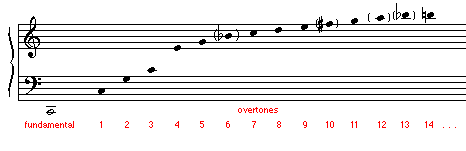
OK - I know them as whistle tones or harmonics. As a daughter of a flute player, I used to hear my Mom's students practicing overtones, or whistle tones by covering all of the key holes on the flute and blowing softly with their flute embrasure, until they produced what sounded like a high pitched whistle. By blowing a little harder, they could make the whistle produce a pattern of notes above the original whistle tone. The actual notes are specific, in other words, you won't hear a diatonic or chromatic scale. You hear the original note, then the octave above, then the fifth above that, then the fourth above that, then the third above that, and so on, as pictured in this graphic here.
You've probably seen stringed instrument players; violinists, guitarists, bass players, even harpists, tune with overtones. And there are plenty of pieces written for instrumentalists that use these sound effects, if I can call them that.

But, singing overtones?

I can't find the break in my voice halfway in the middle and I don't have an voice embrasure! The words are English, but singing overtones?? That is nuts. It doesn't even make sense.

Well, while attending a vocal seminar in Monterey last Fall, Directed by The Choral Project's Artisitic Director and Conductor, Daniel Hughes, I finally found out how to produce overtones while singing.

Here's a sample of me singing overtones into my iPhone video camera!


Pretty cool huh? Can you hear the overtone series? Play it again, a couple of times. If you listen carefully, you probably will start hearing them more and more! What a fantastic way to train your ear to hear more than the average listener!

So, how did I do it? This is the way Daniel Hughes taught us, in a nutshell. Here's the secret:
  • Sing a D (right above middle C on your piano)
  • While you are singing the D, sing the sounds "oh - oo - er - ee"
On the site: http://www.spectralvoices.com/techniques.htm: the post suggests:
"Vowel sounds and lip shapes are important in fine-tuning the harmonics. The lowest harmonics are emphasized with tight "oo" sounds, while increasingly higher harmonics can be heard as vowels change through "oh...awe...ah...ay...ee," and everything in between."

You try it. It's a lot of fun. I intend to practice until I get really good.

Add some comments here on how you produce overtones while singing.

Thursday, March 25, 2010

I am an Athlete; I sing!

posted by Ruth Butterfield-Winter

Are musicians in good physical shape?

I just came back from a 20 minute run; I need to break in my brand new running shoes. As I was running, I was thinking about this: If I am in good shape physically, will I be a better musician? The only answer I could come up with was, "Of Course!" But, why is this the case?

I remember studying piano at the Curtis Institute of Music, in Philadelphia. I was in a practice room one morning working on a difficult piece. Time flew by, partly because I was enjoying the process, but also because I needed to "woodshed" certain passages for technique. I stopped to take a break and realized that I was sweating! I was sitting down the whole time! How could I be sweating? I realized at that moment that I am an athlete!

I recently started singing, outside my shower, on a regular basis. Many times, the music requires that I sing a sustained pitch for a long time. I have noticed a big difference in my ability to produce long (in duration) tones when singing since I've started running. My body is stronger and my lung capacity is more controlled, and I don't get as exhausted after a rehearsal, as I did before I started running. I am learning to use the muscles available for singing correctly. Therefore, for me, as a singer, I am an athlete.

Musicians are athletes!

Granted, there are many musicians who don't look like marathon runners (not many members of the general population do)! However, in order to play, or sing, through 5 - 45 minutes of music without a break, you need stamina. Have you ever looked at a bass violinist's hands, or watched the abdomen of a flute player. Next time you get a chance, look at the embrasure of a brass player. Musicians are sexy defined athletes. We should have a magazine called "Musician's Illustrated" and feature the latest lips on the cover.

Monday, March 8, 2010

Talent vs. Skill

posted by Ruth Butterfield-Winter
If you had to choose between having talent or skill, what would you choose? Of course you would say, "I would rather have both." But, what if you could only have one, which would be better?

Some people are born into their talent; Both parents are doctors, the daughter might have a better understanding of medicine than a girl born of a pastry chef. And the pastry chef's daughter, most likely, will be a better cook. 'Not necessarily,' you might say, but it's possible; and does happen quite often. Let's say, the daughter of the doctor wants to learn the skill of baking. She can learn to bake and hone her skill to become a great pâtissiere.

I was thinking about talent vs. skill during our trip to Arizona. What about music? If you are saturated from an early age in music, maybe Mom played "Baby Einstein" on her tummy while you were in the womb. Or one or both of your parents were musicians, and you were born first (like me). Very likely, you would have a sense of music and have an innate talent for it. However, there is the possibility that even if your your environment, at an early age, was saturated with music, you may emerge with little or no talent. Your Mom or Dad may insist on giving you piano lessons and you just rebel, with a vengeance. But you find that you like to sing and you pursue that. Let's say, at first, people ask you to stop singing because it is so unbearable, but you're a kid and anything kids do, is darn cute. But as you get older, you just can't hold a pitch in a bucket! Can you acquire the skill to sing well?

I think you can. I believe that if anyone wants to do something bad enough, they will be able to do it. I believe that's called passion. With honest guidance from a professional and trusted teacher, an "untalented" musician can be taught the discipline of music. They can hone the skill. To develop a true ability to sing (or do anything) requires a lot more courage and push than someone needs if she has pure talent.

Superficially, talent is better. But, let's say you have the talent. If someone puts a piece of music in front of you and asks you to sing it or play it, you can easily read it or do a damn good job of faking your way through it. You have the talent to float by with minimal work. Relying on your talent is so dangerous, in my opinion. It is so easy for a person to go to rehearsals and "sight-read" every run-through. The "sight-reading" is not perfect, but it is good enough and the talent is there to make the rehearsal productive. But, what of the subtle mistakes. What of the intimacy of knowing the piece cold. Being able to make the part your own, with the control necessary, so that if nerves overwhelm you, you can fall back on the muscle memory and technique you developed in the practice room.

Yes, for me, if I had to choose between talent and skill, I would choose talent. But without skill, i.e. technique, practice, discipline, & passion; talent is meaningless.

What do you think?